Brand Strategy · Consumer Behaviour · Sustainability
When Does Sustainability Feel Authentic in Luxury?
Luxury brands are talking more about sustainability. But the more interesting question is whether consumers actually believe them.
Yash Bahade · 5 min read · 2026
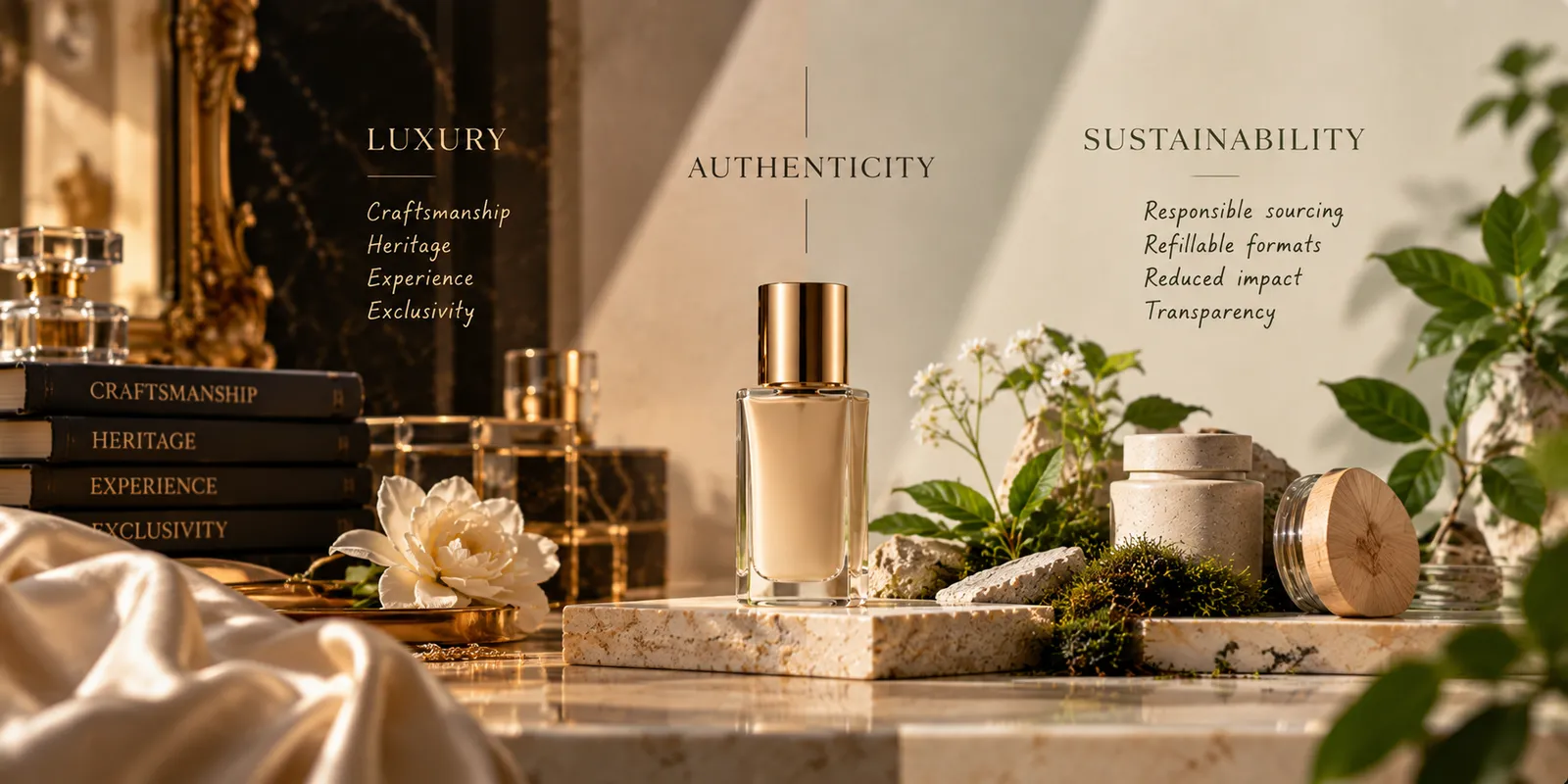
Luxury has always been built around stories.
Craftsmanship. Heritage. Rarity. Quality. Attention to detail.
More recently, another idea has become increasingly visible in those stories: sustainability.
Brands talk about responsible sourcing, recyclable packaging, natural ingredients, refillable products and environmental commitments. In beauty, terms such as clean, green and responsible have become increasingly familiar.
But while working on my master's thesis, I became interested in a slightly different question.
“What happens when consumers don't simply accept those claims?”
Because saying something is sustainable and being perceived as sustainable are not necessarily the same thing.
The question started with luxury beauty
My thesis explored how sustainability and clean beauty claims influence consumer perceptions and purchase decisions in luxury beauty.
I initially approached the topic from a fairly straightforward marketing perspective.
If consumers increasingly care about environmental and ethical issues, then communicating sustainability should presumably create additional value.
But the more I explored the subject, the more complicated it became.
Luxury itself carries certain expectations.
Consumers might expect beautiful packaging, premium materials, strong performance and a sense of exclusivity. Sustainability can introduce a different set of expectations around restraint, responsibility, transparency and environmental impact.
Those ideas aren't necessarily incompatible.
But bringing them together convincingly is not as simple as adding a sustainability message to a campaign.
Consumers don't evaluate a claim in isolation
One thing that became particularly interesting during my research was how much context matters.
A sustainability claim doesn't exist by itself.
Consumers interpret it alongside what they already know about the brand.
They look at the packaging.
They think about the price.
They consider the ingredients or product performance.
They may compare what the brand is saying with what they believe the company actually does.
And sometimes, they simply ask whether the claim feels believable.
That last word became increasingly important to me:
believable.
Because a sustainability message can sound positive while still creating scepticism.
The greenwashing problem
The difficulty for brands is that consumers have become familiar with the idea of greenwashing.
A package can be green.
A campaign can talk about nature.
A product can use words such as clean, natural or responsible.
None of those things automatically tells a consumer how meaningful the underlying action actually is.
This creates an interesting problem for marketers.
The more brands communicate sustainability, the more consumers potentially have to evaluate which claims they trust.
And when the communication feels vague, exaggerated or disconnected from the rest of the brand's behaviour, a positive message can create the opposite reaction.
Instead of increasing trust, it can create questions.
Sometimes less communication may feel more credible
This was one of the ideas I found most interesting while thinking through the topic.
Marketing usually encourages brands to communicate their advantages clearly.
If you've improved something, tell people.
If you've introduced a new initiative, explain it.
If you've made progress, make sure consumers know.
Sustainability complicates that logic.
A brand that talks too loudly about a relatively small environmental improvement may invite more scrutiny than appreciation.
Consumers can start asking:
How significant is the change?
What isn't the brand telling me?
Is this genuinely an improvement, or is sustainability simply being used as another marketing message?
That doesn't mean brands should communicate less.
I think it means they need to give consumers something concrete to believe.
Proof becomes part of the message
This is where sustainability communication becomes particularly interesting from a marketing perspective.
The strongest message may not be the word sustainable itself.
It might be explaining what actually changed.
A refillable format.
A packaging reduction.
A clearly explained sourcing decision.
A measurable commitment.
A certification consumers can understand.
Or simply enough transparency for someone to make their own judgement.
The communication moves from:
“Trust us, we're sustainable.”
towards:
“Here's what we're doing. You can decide what you think about it.”
That feels like an important distinction.
Luxury makes the tension even more interesting
Luxury adds another layer because sustainability isn't the only thing consumers are buying.
They're also buying experience.
A beautiful bottle can be part of the pleasure of using a fragrance or skincare product. Packaging can communicate craftsmanship and quality. Weight, texture and presentation can all contribute to how premium something feels.
So simply removing everything in the name of sustainability may not necessarily create a better luxury experience.
The challenge becomes more nuanced:
“How can a brand reduce unnecessary impact without removing the things consumers genuinely value about luxury?”
That's a much more interesting design and marketing problem than simply making something look environmentally friendly.
It requires thinking about sustainability as part of the product and experience, rather than something added to the communication afterwards.
Research changed the question for me
When I started exploring this topic, I was largely interested in whether sustainability claims could influence purchase decisions.
I still think that's an important question.
But I've become more interested in what happens before the purchase decision.
Do consumers notice the claim?
Do they understand it?
Does it fit what they already believe about the brand?
Does it feel specific?
Does it feel genuine?
And perhaps most importantly:
“Do they trust it?”
Because if that trust isn't there, the claim may never reach the point where it influences a purchase.
Authenticity isn't a word a brand can give itself
That's probably the biggest idea I've taken away from working on this topic.
Brands can communicate sustainability.
They can provide evidence.
They can make commitments.
They can change products, packaging and processes.
But they can't simply announce that those actions are authentic.
“Authenticity is ultimately an interpretation made by the consumer.”
For marketers, that makes sustainability communication more difficult.
But it also makes it more interesting.
The challenge isn't simply finding a better way to say that a brand is responsible.
It's making sure there is something meaningful behind the message in the first place.