E-commerce · E-retail · Digital Operations
The Invisible Work Behind an E-Commerce Product Page
What looks like a simple product listing to a shopper can involve surprisingly complex systems, data and manual work behind the scenes.
Yash Bahade · 5 min read · 2026
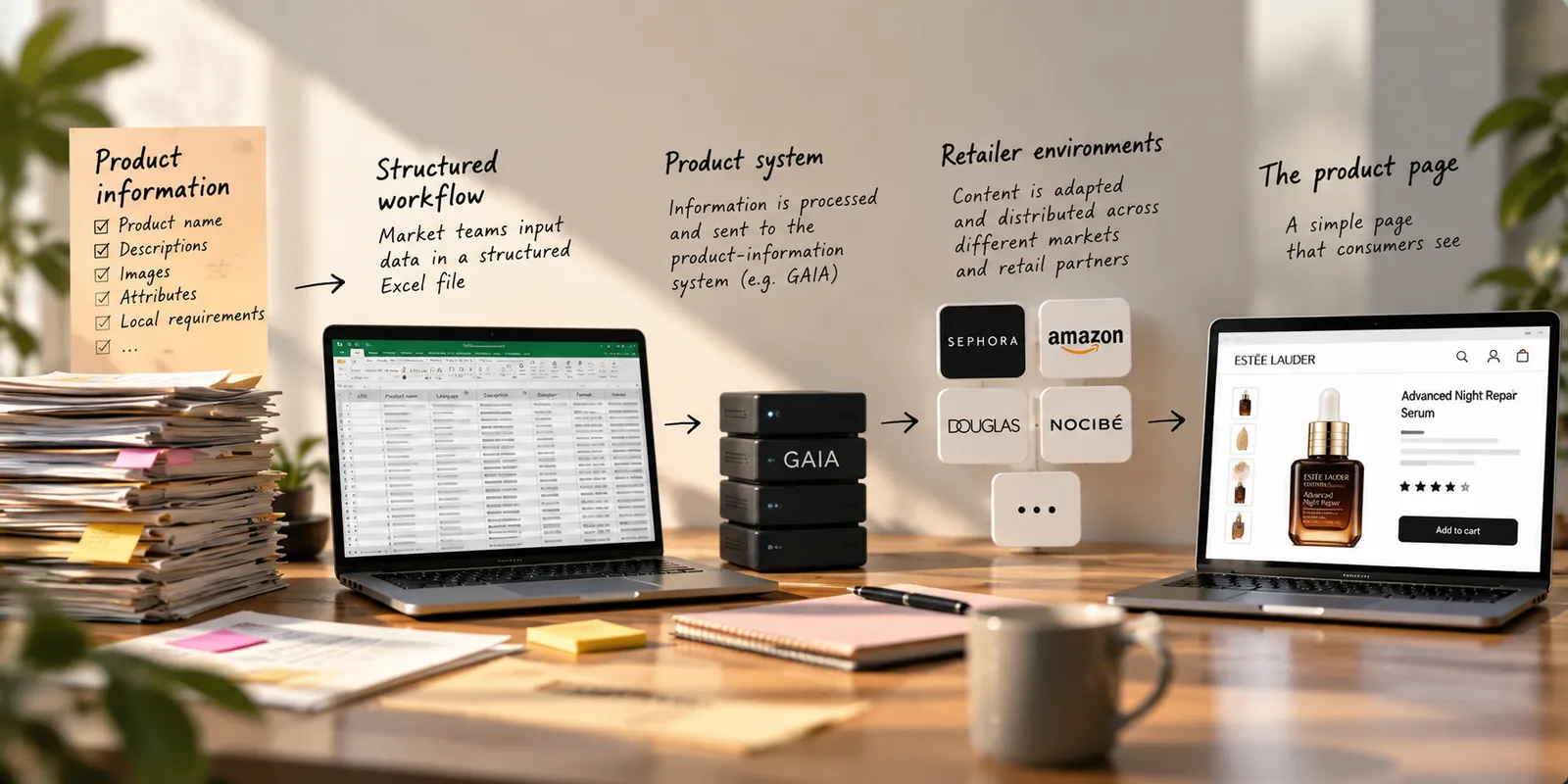
Before working in e-retail, I never really thought about what had to happen before a product appeared on a retailer's website.
As a consumer, the experience seems simple.
You search for something. You open a product page. You look through the images, read the description, compare your options and perhaps click "Add to cart."
During my internship with Estée Lauder Companies' EMEA e-Retail team, I started seeing the other side of that page.
Behind something as ordinary as a product listing were product information, images, descriptions, different markets, retailer environments, systems and a surprising amount of manual work.
It made me realise that the digital shelf we see as consumers is really just the visible end of a much larger process.
A product page is more than a page
When we talk about e-commerce, it's easy to focus on the parts consumers can see.
The website design. The campaign driving traffic. The product photography. Reviews. Promotions. Recommendations.
But before any of those things can help someone make a purchase, the basic product information has to be there, and it has to be right.
A shopper needs to understand what the product is, what it does, which version they're looking at and whether it's relevant to them.
That sounds obvious.
What wasn't obvious to me before working in e-retail was how much coordination can sit behind making that happen consistently.
And when you're working across multiple markets and retailer environments, something that looks like a single product from the outside can involve a much more complicated information flow behind the scenes.
The manual work we rarely think about
One of the things that surprised me most during my internship was simply how much manual work can exist behind digital commerce.
We tend to associate e-commerce with automation.
The storefront is digital. Transactions are digital. Analytics are digital. Product catalogues are digital.
So it's easy to assume that the processes behind them must be highly automated too.
That isn't always the case.
Information still has to move between people, files, platforms and systems. Someone has to make sure the right information reaches the right place in the right format.
And repetitive processes become much more noticeable when they have to be performed across many products or markets.
That's where one particular project changed how I thought about e-commerce operations.
From Excel to the digital shelf
During my internship, I was onboarded onto an internal project exploring an Excel–GAIA integration.
Without going into internal systems or processes, the broader idea was relatively straightforward: could product information entered into a structured Excel workflow be integrated more efficiently with the product-information system, reducing some of the repetitive manual work involved?
What interested me was not Excel itself.
It was the problem behind it.
If people repeatedly spend time transferring, preparing or uploading structured information, there is an opportunity to ask:
“Does a person actually need to be doing every part of this?”
And if not, what could the workflow look like instead?
The project was still ongoing when my internship ended, so I never saw its final implementation.
But being involved in it changed how I thought about automation.
Automation doesn't always have to look revolutionary
When we hear the word automation, it's easy to imagine something dramatic: AI replacing an entire process or sophisticated technology fundamentally changing how a business operates.
Sometimes automation is much less glamorous.
It might simply mean removing a repetitive step.
Reducing the number of times the same information has to be handled.
Creating a more structured way for data to move from one place to another.
Or giving someone back a few minutes they would otherwise spend performing the same task again and again.
Individually, those improvements can seem small.
At scale, they become much more interesting.
And perhaps more importantly, they allow people to spend less time moving information around and more time actually using it.
The customer never sees any of this
This is probably what I find most interesting about the digital shelf.
When everything works properly, the customer doesn't think about any of it.
They don't think about product-information systems.
They don't think about spreadsheets.
They don't think about who uploaded an asset, structured an attribute or made sure information reached a retailer correctly.
They simply see a product page.
And that's exactly how it should feel.
But the simplicity of the customer experience can hide a lot of complexity behind it.
“A customer may never notice when product-information infrastructure works perfectly. But they can certainly experience the consequences when it doesn't.”
An incomplete description creates uncertainty.
Missing information creates questions.
Inconsistent content can create confusion.
Poor imagery can make a product harder to understand.
And suddenly, something that looks like a backend operational issue becomes part of the customer experience.
E-commerce sits at an interesting intersection
That experience changed how I think about e-commerce.
I used to see the product page mainly as the place where a consumer evaluates a product.
Now I see it as the point where several different worlds meet.
Brand determines how the product should be represented.
Data structures the information behind it.
Technology and operations help move that information across systems.
Retail determines where and how consumers encounter it.
And ultimately, the consumer experiences the result.
That intersection is one of the reasons I've become increasingly interested in e-commerce and e-retail.
It's not simply about putting products online.
It's about everything that has to work together to make buying something online feel simple.
The best digital experiences often hide their complexity
Working behind the digital shelf made me appreciate something I had barely considered as a consumer:
“Simple experiences aren't necessarily built by simple systems.”
Sometimes the opposite is true.
A product page might take seconds to scroll through, while the information behind it has travelled through multiple people, processes and platforms before reaching the screen.
And perhaps that's one sign of a good digital experience.
The complexity stays behind the scenes.
The customer simply gets what they need.